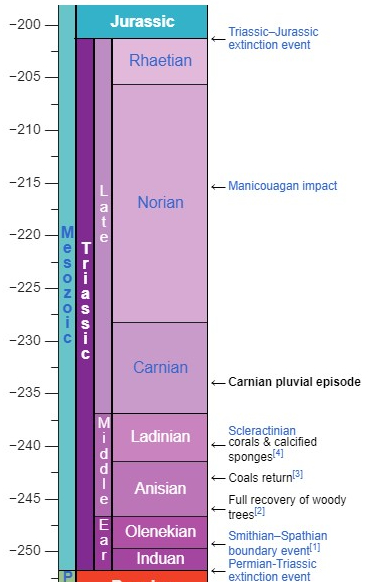
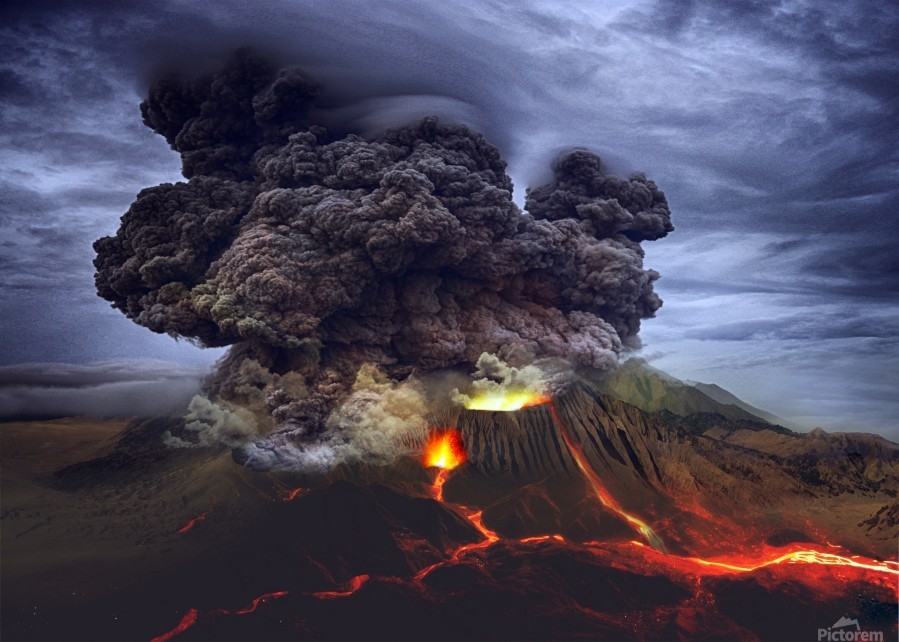
In the late parts of the Carnian stage, for about 1-2 million years, there was major volcanic activity leading to heavy rainfall, mass species extinction, earthquakes! This period is known as a Mass-Extinction Event.
The word Pluvial is derived from the latin word 'pluvalis', which means rain. That's where it gets it's name! The Carnian Rain Event. Similarly, 'fluvial' is a word to mean 'floods'!
Evidence for the Carnian Pluvial Episode can be found by many Carnian strata worldwide in both oceans and on land. On land many arid climates have seen geological evidence for runoff, which would have needed to been caused by a lot of rain. Erosion and movement of the continent Pangea would have accelerated in this time, likely because of all the rain breaking up Pangea more! In oceans, many rocks such as limestone have been seen to have increased deposition of mud in their tables, as many carbonate lifeforms died out in this event.
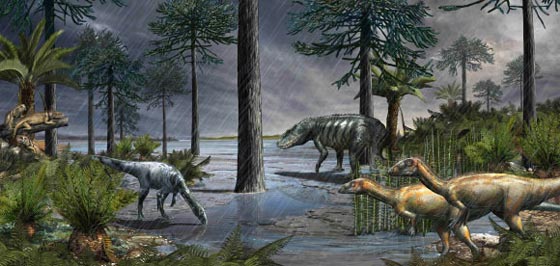
The Late Triassic period was classified as very arid, until this key event making things much more humid. There was a great global warm of about 4-8C, likely due to the sediment blasted by the volcanos. In many reigons, all the rain turned rivers into sludges of sand, silt, and rocks. And the death of many carbonate lifeforms was disastrous and made a lot of the water very acidic. In most Mass Extinction Events, this causes black shoals to form, but the Carnian Pluvial Episode was notable for a lack of these shoals.
The dinosaurs of this time are all dead now. Though this Mass Extinction Event was thought to contribute majorly to dinosaur diveristy. Looking at footprints before and after, it is notable how after the Episode dinosaurs got way cooler and different. Plants also diversified, having to learn how to survive in such an environment, and the mass extinction.
Mqryxcfzu Qqrvyprfavw, grx dus hivh gkkps kn Kse
/wypiimqh/q/1RyONsJE3fxxC0rb0tiwdBy-NroggKIKUS1i66Ijtcrj/xnvh?qas=rebfrgzs